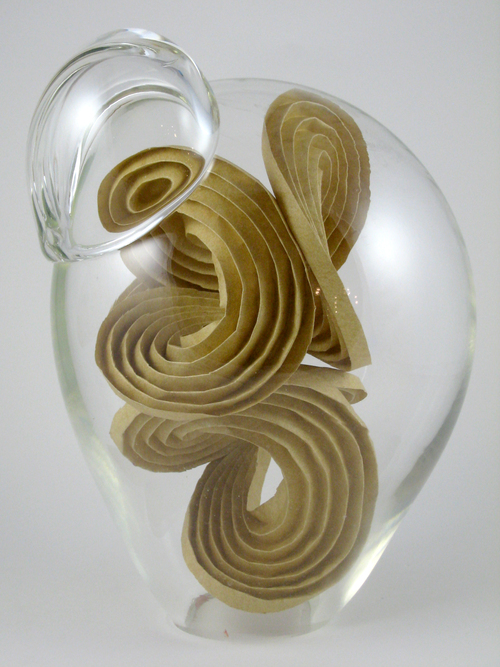
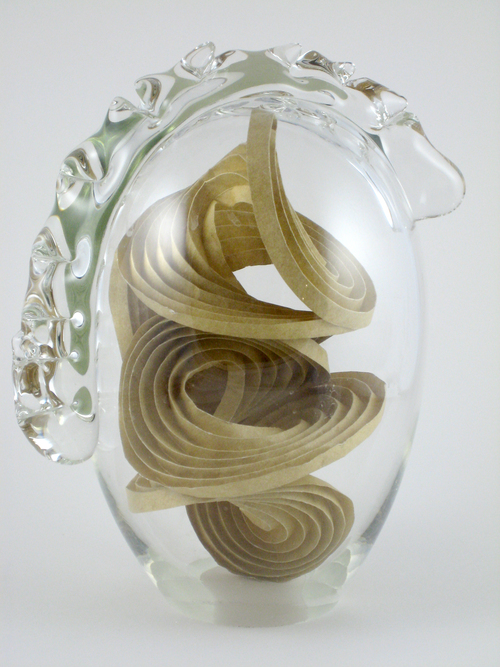
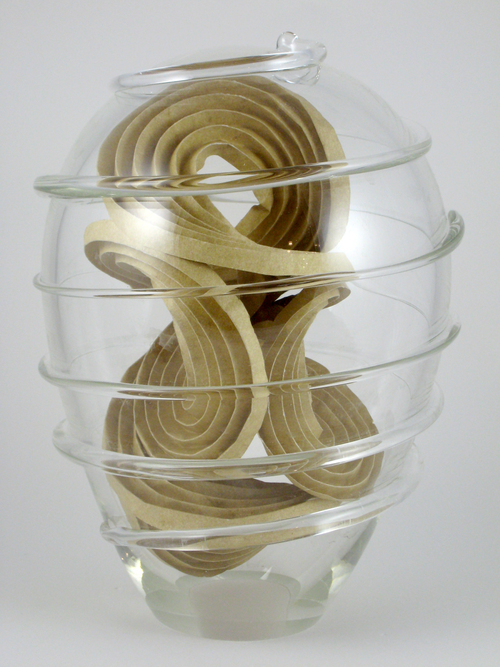
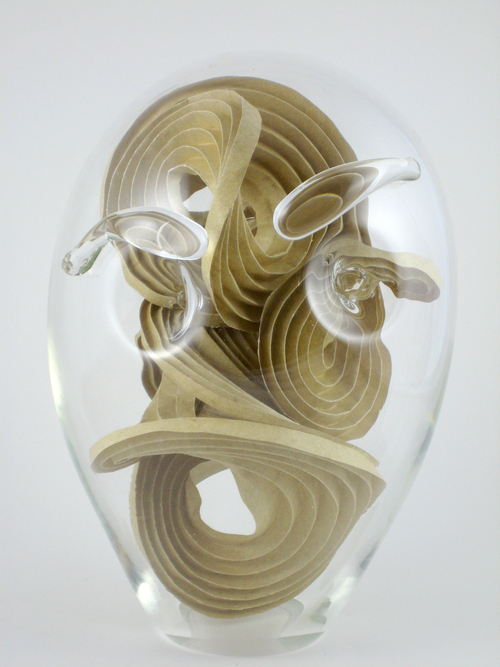
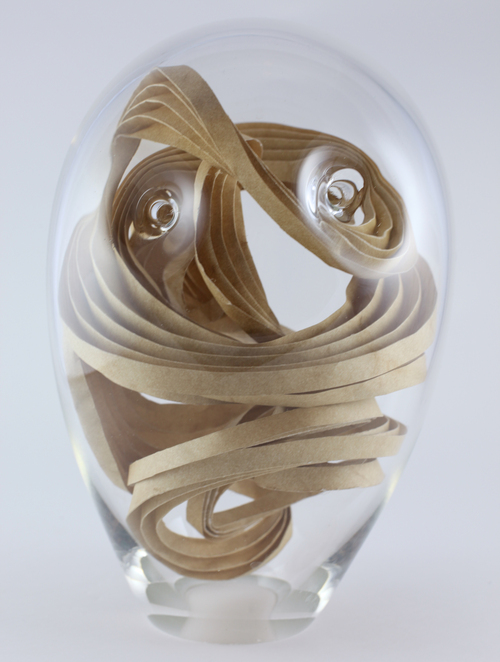
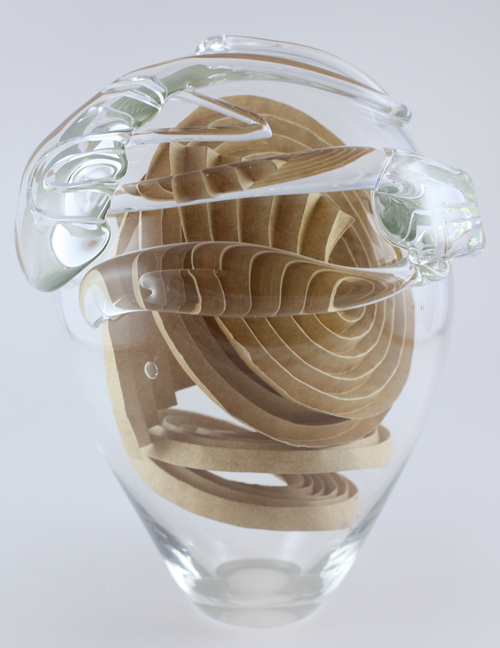
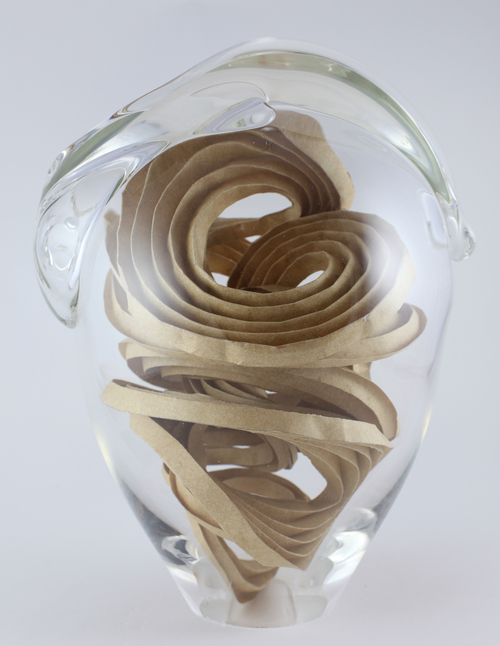
Each piece in this series is a hand-blown glass hollow “head” containing a hand-folded piece of paper with curved creases. The glass heads were made after an experience (documented in video) of blowing glass blindfold, touching the glass through wet paper.
“Waves in Glass” is about the communication between two media rarely combined—folded paper and blown glass. The glass was initially made while blindfold, as shown in the video above, so that the communication with the 2000° material is purely through touch, matching the dominant mode of communication with paper.
We have worked together for several years in both glass sculpture and paper sculpture, and have longed to create sculpture from both media in a way that they relate to one another—that they communicate. To start with, we as artists must communicate with the material. Paper relies on touch. The tactile interaction lets you talk to the paper, asking it to bend, and you can hear the material responding, as the folds form the shape.
Glass is hot, over 2000 degrees Fahrenheit, making it untouchable. Glass blowers rely on visual cues to communicate and shape this amorphous material. In order to make it relate to paper folding, we blow glass blindfold, leaving touch as the only way to communicate. Touch is possible through a thin layer of wet paper, which serves as the communication interface between the artist and the material. This experiment brought a new sensitivity and awareness in communication with the glass and between paper and glass. After the experience, we returned to making glass while sighted, and found that our perception changed and the physical sensation was heightened, while we continued to shape the hot glass through wet paper.
The communication between paper and glass continues through the curved-crease sculptures placed inside the glass forms. We use computers to design these sculptures, based on algorithms from the field of computational origami. Here we fold paper along concentric circular creases, a design originating at the Bauhaus in the late 1920s. Creases set the memory of the paper so that it tries to return to a specific dihedral angle, while uncreased paper tries to remain flat. Confined to open within a glass enclosure, the paper finds new equilibrium forms, which would not exist without the communication between the materials. We chose a head shape for the glass to hold the paper, as it embodies most forms of human communication: vision, voice, hearing, and smell.
As scientists we are concerned with how to best communicate new discoveries and processes. We use sculpture as a way to express our research to a broad audience, illustrating the beauty of mathematical structures through the design of physical manifestations. We find that the dialog between our scientific work and our artistic work inspires both our art and science in directions that would not be possible in isolation.
Material: Elephant hide paper, hand-blown glass.
Dimensions: each 8" × 8" × 10" tall.
Check out our other curved-crease sculpture, as well as our history of curved-crease sculpture.