Computational Origami (2008)
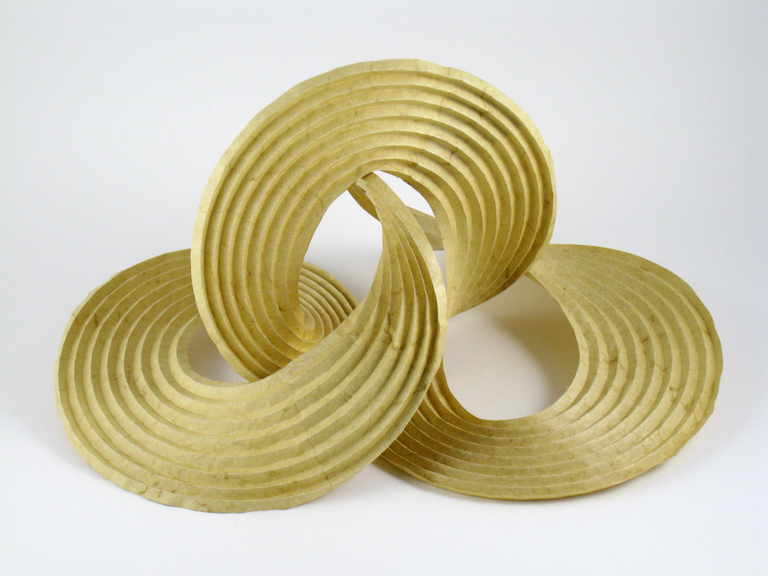
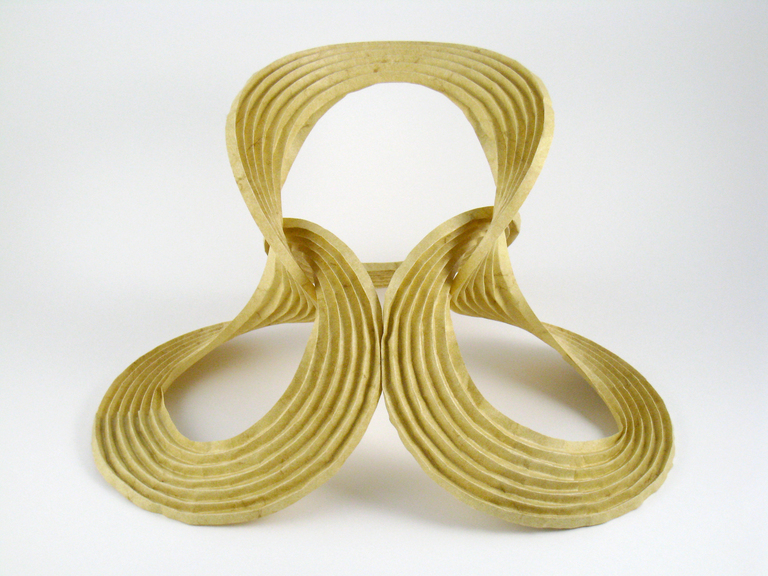
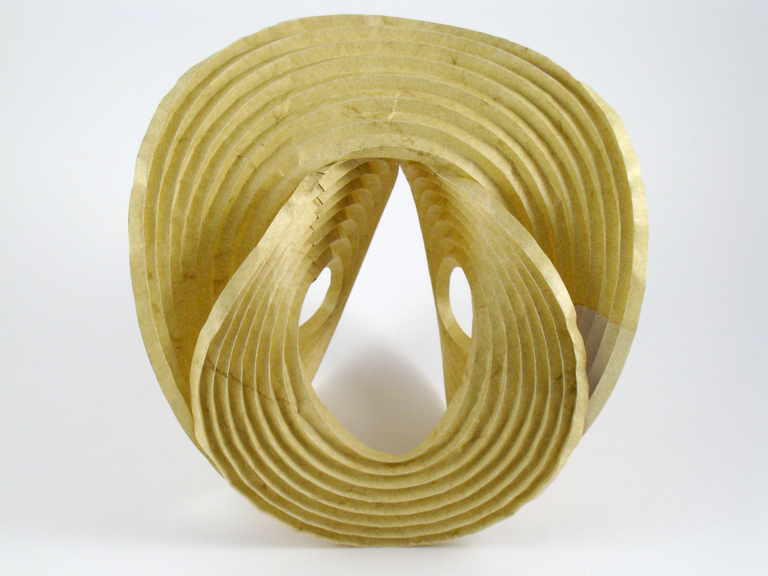
This series of three pieces, titled “Computational Origami”,
is part of the Museum of Modern Art (MoMA)
permanent collection.
It was originally part of the
Design and the Elastic Mind
exhibit from February 24 to May 12, 2008.
Then it was on display in The Philip Johnson Architecture and
Design Galleries (third floor) as part of the
Rough Cut: Design Takes a Sharp Edge
exhibit, November 26, 2008 to October 12, 2009;
and as part of the
Applied Design
exhibit, March 2, 2013 to January 20, 2014.
Pieces
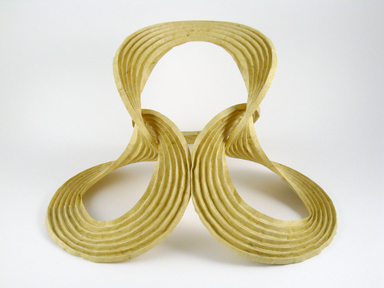
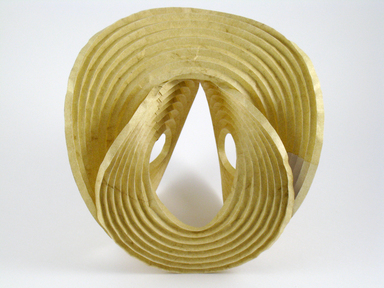
About the Pieces
Each piece in this series connects together multiple circular pieces of paper
(between two and three full circles) to make a large circular ramp of total
turning angle much larger than 360° (between 720° and 1080°).
Each sculpture is also turned a different amount before joining the sliced
circles into one big (topological) circle.
The title “Computational Origami” refers to our underlying
algorithmic goal of determining the mathematical curved surface that results
from different kinds of pleated folding. This kind of “self-folding
origami” may have applications to deployable structures that can
compress very small by folding tightly and later relax into its natural curved
form. To control this process, we must understand what forms result from
different pleatings, and how to design pleatings that make desired forms.
Material: Elephant hide paper.
Dimensions: 9" × 13" × 7" tall •
8.5" × 13" × 7" tall •
8" × 7" × 8.5" tall.
For More Information
Check out our other curved-crease sculpture,
as well as our history of curved-crease sculpture.